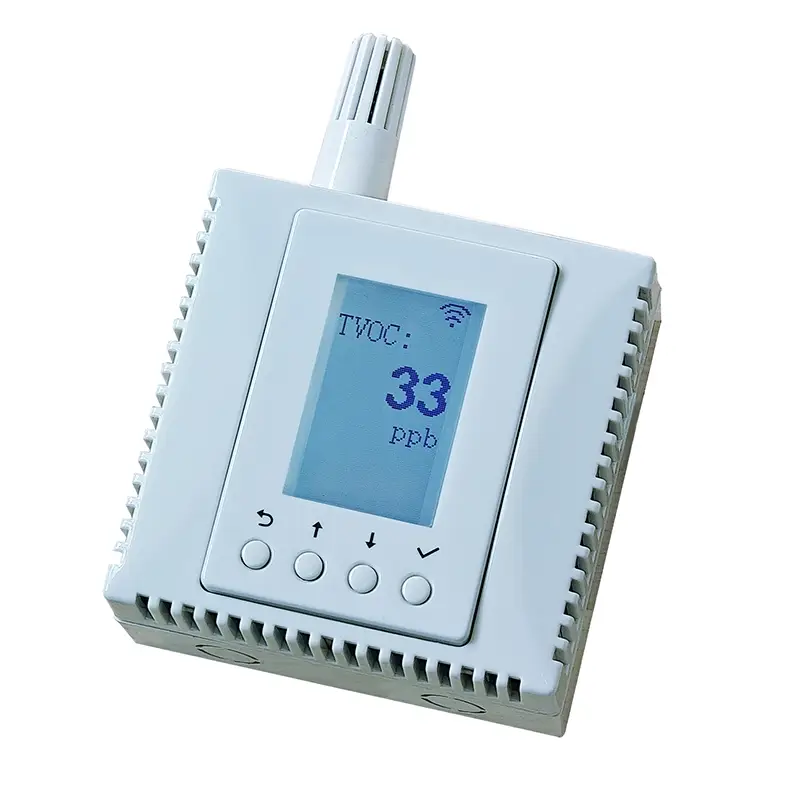
MN-WVOC WiFi 4-in-1 Air Quality Monitor | Industrial Multi-Protocol IoT Sensor
Buy from Amazon


Origin: China | HS Code: 8517.62.3990
Wi‑Fi Provisioning with the Monigear App
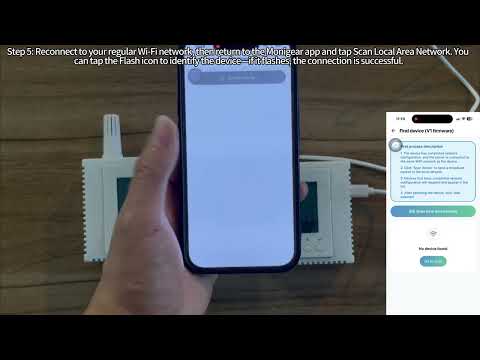
Step-by-step guide to provisioning your Monigear WiFi products via the Monigear App on iOS devices.

Step-by-step guide to provisioning your Monigear WiFi products via the Monigear App on Android devices.
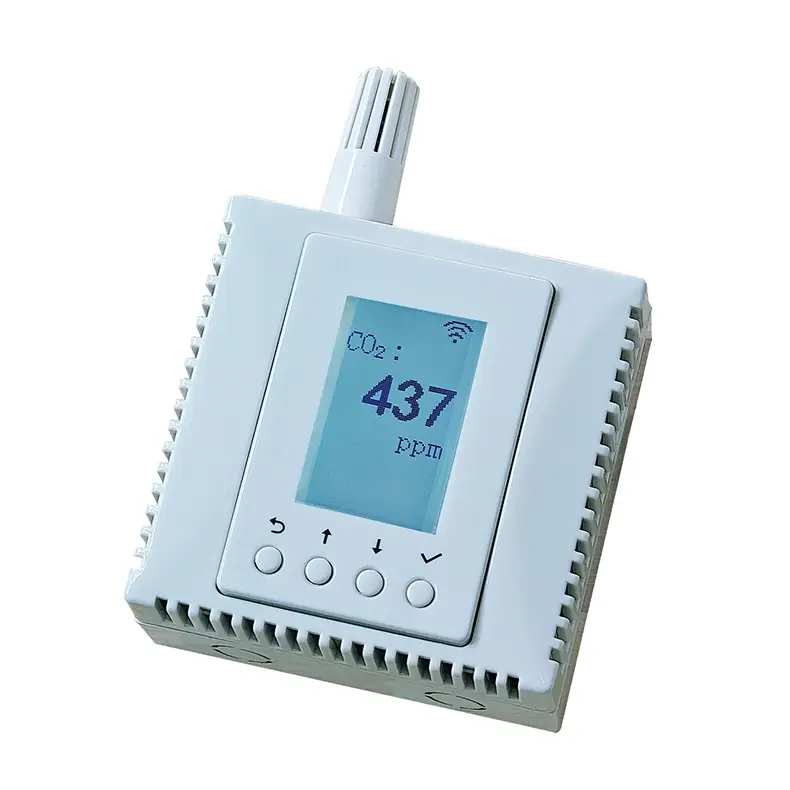
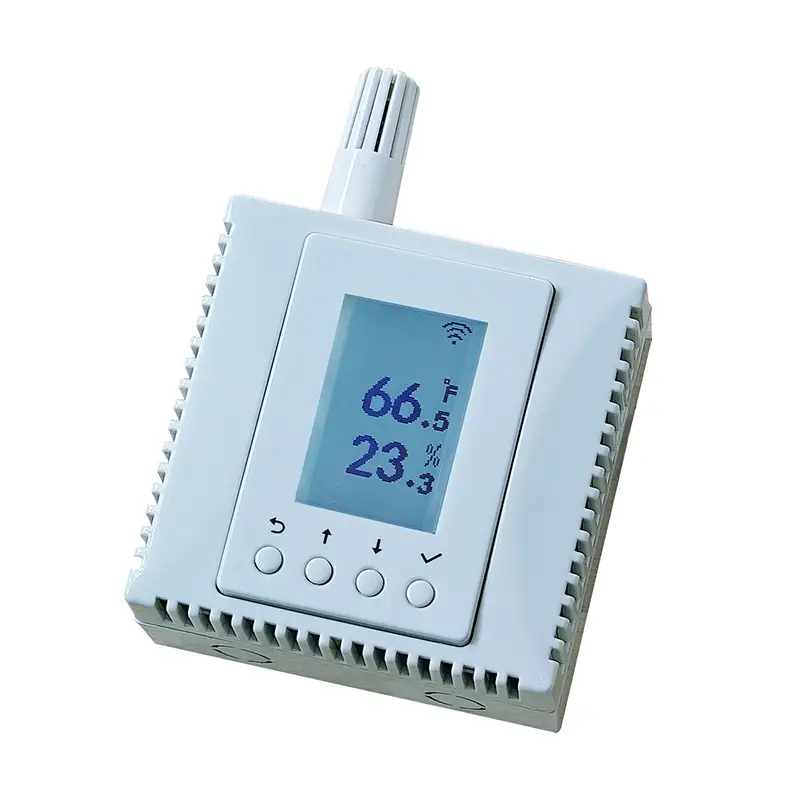
The MN-WVOC Wifi 4-in-1 indoor air quality monitor is an environmental monitoring module independently developed by our company, which can measure and display TVOC, CO₂,environmental temperature and relative humidity. Designed for reliability and seamless integration, this sensor delivers real-time, accurate readings to ensure optimal indoor conditions.
Key Features
- 4-in-1 Environmental Monitor (TVOC, CO₂,Temperature,Humidity). High accuracy:Temperature measurement accuracy: ± 0.3° C; Humidity measurement accuracy: ±3%;CO₂ measuring range: 0-2000ppm.
- Supports Multiple Industry-Standard Communication Protocols: Modbus TCP, SNMP, BACnet, and MQTT. Our system is compatible with all these protocols and can deliver data in multiple formats simultaneously. Comprehensive support for SNMP v1/v2/v3 and SNMP Trap v2c/v3 with high security level.
- A web service can be enabled to view sensor data directly through a browser. Support for the REST API protocol can also be enabled to return JSON data from the sensors. However, these two features are disabled by default for network security reasons, and can be enabled by configuration tool.
- Advanced SNMP Support: Full compatibility with SNMP v1/v2/v3 and SNMP Trap v2c/v3, featuring enterprise-level security for critical infrastructure monitoring.
- Can be integrated to AWS/Azure/Tuya IoT cloud directly with low cost. Can be directly integrated into Home Assistant
- Proactive Alerts – Instant email notifications when thresholds are exceeded (fully customizable triggers). IFTTT Automation – Trigger smart actions (e.g., activate HVAC, log to Google Sheets, or Telegram alerts) via Webhook integration.
- Wifi network. Provides reliable Wi-Fi connectivity with native support for WPA-Enterprise and 802.1X authentication, enabling seamless integration into enterprise-grade security architectures.
- Supports standard USB Type-C 5V power supply. Supports DC power terminal supply, rated input voltage DC12V, range DC9~28V.(The DC power supply terminals are inside the box.)
- Easy to use: A graphical interface configuration tool supporting Windows, Linux, and macOS platforms with online remote upgrade capability for simplified product deployment and maintenance.
- Sleek, Durable Design: Compatible with standard 86×86 junction boxes, featuring a flame-retardant PC housing that meets stringent safety standards while complementing modern building aesthetics.
- Professional Certification: Certified through FCC/CE-RED/ROHS, meeting the high standards and strict requirements of the market.
- Your Data, Your Control: MONIGEAR's sensor puts security first—whether cloud-connected or fully self-contained.
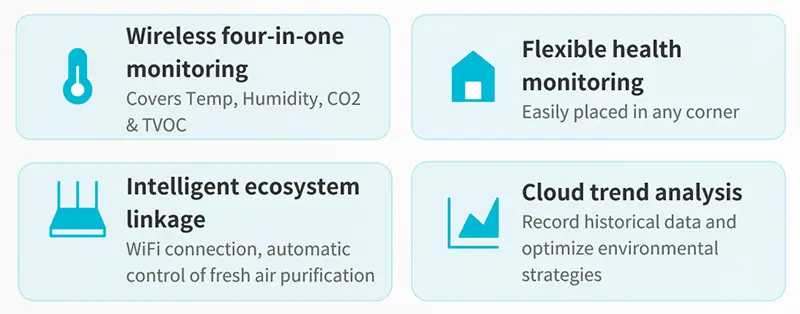
Typical Scenarios
For detailed information about the capabilities across all our Network Sensors, please visit our common features page.
Technical Specifications
| Measurement Range | Temperature: -30°C~85°C (-22°F~185°F); Humidity: 0-100% RH; Carbon dioxide concentration: 400ppm–2000ppm; TVOC: 0-10,000 ppb |
|---|---|
| Measurement Accuracy | Temperature: ±0.3°C @0-65°C (±0.54°F @32-149°F); Humidity: ±3%@10-90% RH; Carbon dioxide: ±(50ppm+5% of reading); TVOC: typical error of <12% of the measured value |
| Communication Protocol | Supports multiple TCP/IP application layer protocols: MQTT/MQTTS, ModbusTCP, SNMP, BACnet, REST API, email etc. |
| Device Power Supply | Supports standard USB Type-C 5V power supply. Supports DC power terminal supply, rated input voltage DC12V, range DC9~28V.(The DC power supply terminals are inside the box.) |
| Power Consumption | 0.5W |
| Operating Storage Temperature | -30~+85℃ (-22°F~185°F) |
| Operating Storage Humidity | 5~95% RH, non-condensing |
| Product Dimensions | 86*86*48 mm |
Frequently Asked Questions
For questions about WiFi provisioning, fixed IP assignment, multiple device setup, and App usage, please refer to the MN-WTHM FAQ section.
What types of volatile organic compounds (VOCs) can the MN-WVOC detect?
The MN-WVOC is equipped with a high-sensitivity Metal-Oxide-Semiconductor (MOS) sensor that provides broad-spectrum response to a wide range of volatile organic compounds commonly found in indoor environments, including alcohols, benzene derivatives (aromatics), ketones, aldehydes, hydrogen, and certain oxidizing gases.
The device continuously monitors gas molecules released from the following pollution sources and calculates a Total Volatile Organic Compound (TVOC) concentration value to provide a comprehensive air quality assessment:
- Alcohols: Such as ethanol, commonly found in alcoholic beverages, disinfectants, and some personal care products;
- Aromatics (benzene series): Such as toluene, commonly found in paints, coatings, adhesives, and new furniture;
- Ketones: Such as acetone, commonly found in nail polish removers and degreasing cleaners;
- Other VOCs: Including cooking fumes, perfume sprays, and various organic gases emitted from household products.
Note: The MN-WVOC monitors and outputs the total concentration of the above gases as a single TVOC value — a composite indicator of overall pollution levels. It does not differentiate between individual gas species or provide separate concentration readings for specific gases.
After initial installation, the readings seem consistently low. Is the sensor accurate?
Low initial readings are normal and result from the combined effects of the sensor's physical adaptation and automatic calibration logic:
1. Physical environment adaptation: When the sensor is first removed from its packaging, it transitions from a high-VOC environment (caused by outgassing from packaging materials) to the actual indoor air. The gas-sensitive material on the sensor surface undergoes a desorption and re-equilibration process, during which readings gradually adjust until the sensor stabilizes with the ambient environment.
2. Automatic Baseline Correction (ABC) algorithm: Upon power-on, the sensor runs an Automatic Baseline Correction algorithm that typically requires 24 hours of continuous operation. During this calibration phase, the algorithm learns and establishes a baseline for the environmental background concentration. In the first few hours after power-on, because there is no historical minimum value as a reference (or the reference has not yet converged), the algorithm applies filtering to the raw data before the baseline is locked, which can result in lower initial readings.
Note: Although absolute values may read low during the calibration period, the sensor responds to relative changes in gas concentration in real time. If you open a window for ventilation or bring a volatile aerosol source (such as alcohol or perfume) near the sensor, you will still observe significant value fluctuations. After the 24-hour calibration period, the device locks its baseline and provides accurate air quality data.
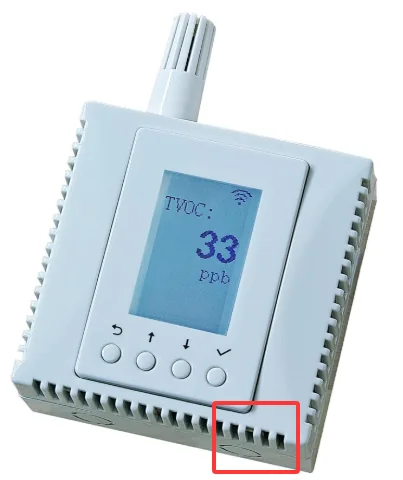
When I exhale directly onto the external probe, why don't the CO2 or TVOC readings change much?
On the 4-in-1 MN-WVOC, the external probe houses only the temperature and humidity sensor — this is because heat generated by the internal circuitry could affect temperature measurement accuracy if the temperature sensor were placed inside the housing. The CO2 and TVOC sensors are located at the inner edge of the device housing — the area marked by the red outline in the adjacent image. To observe a clear CO2 or TVOC response from breath testing, exhale toward this position on the device rather than directly at the external probe.