MN-WENS WiFi Temperature Monitor | Industrial Multi-Protocol IoT Sensor
Buy from Amazon


Origin: China | HS Code: 8517.62.3990
Wi‑Fi Provisioning with the Monigear App
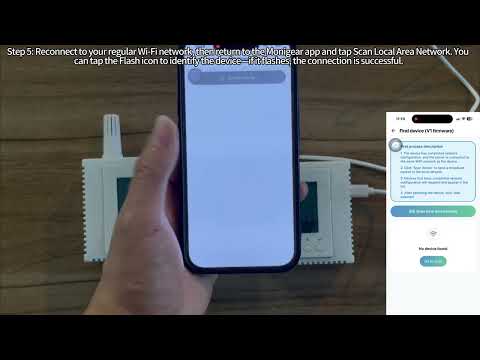
Step-by-step guide to provisioning your Monigear WiFi products via the Monigear App on iOS devices.
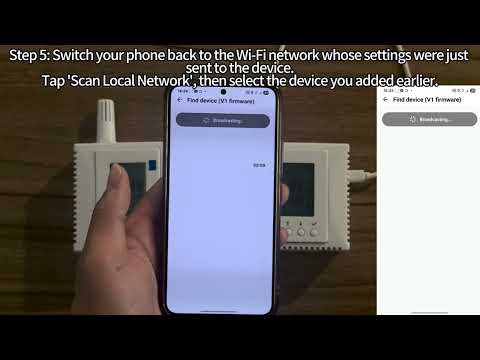
Step-by-step guide to provisioning your Monigear WiFi products via the Monigear App on Android devices.
About This Variant
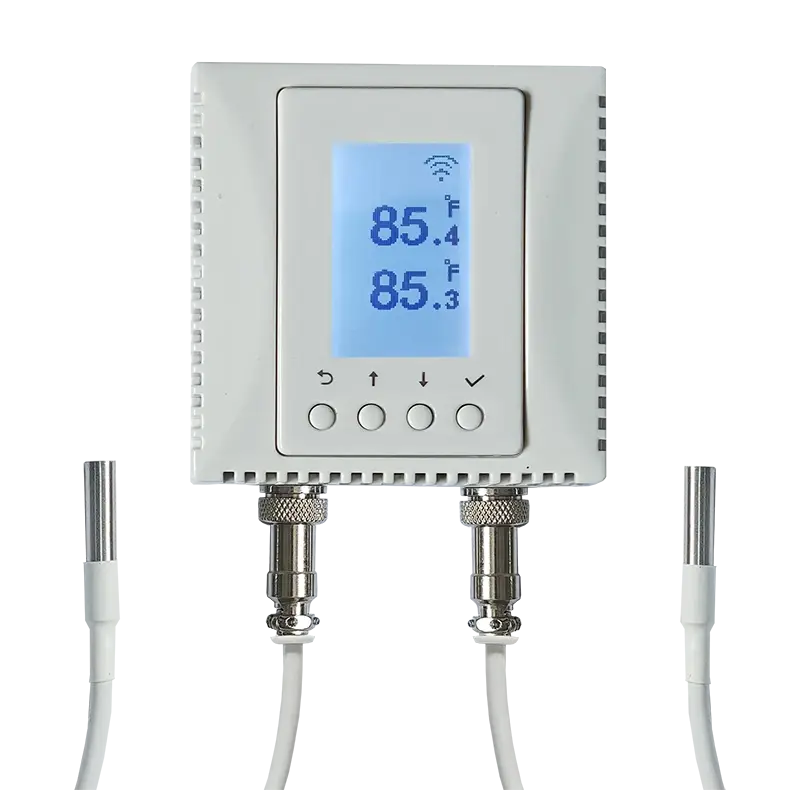
MN-WENS-TN: Temperature monitor with standard temperature probe (MNAC-TN) featuring robust cable for general use applications.
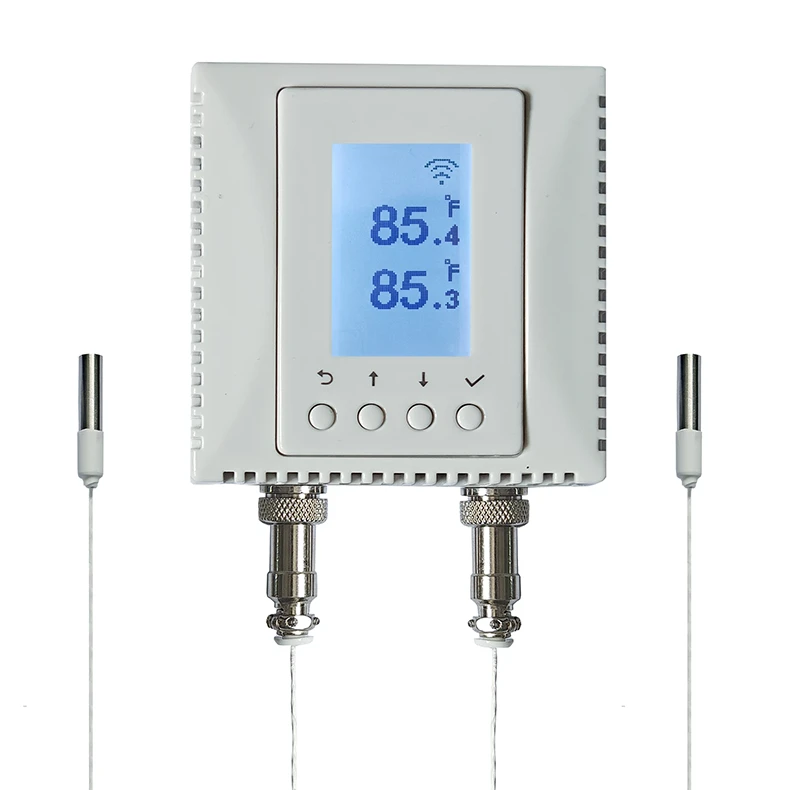
Upgrade your temperature tracking with MONIGEAR's professional-grade temperature sensor. Engineered for versatile deployment, they deliver precise, real-time readings for water tanks, ventilation ducts, refrigerators and freezers. Our ultra-thin probe cables are specially designed to minimize cold air leakage, making them ideal for cold storage equipment. Built for dependable performance and easy integration, they suit a wide range of industrial and commercial temperature measurement needs.
Key Features
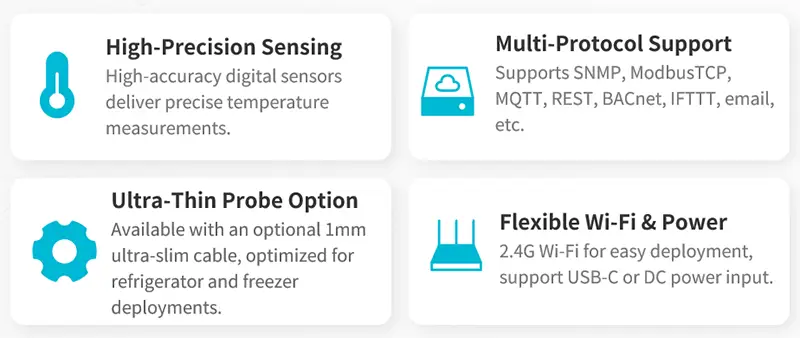
- Industrial-Grade Connectivity: Seamlessly integrates with MQTT, BACnet, SNMP, and Modbus TCP protocols, ensuring compatibility with existing building management systems and IoT platforms.
- A web service can be enabled to view sensor data directly through a browser. Support for the REST API protocol can also be enabled to return JSON data from the sensors. However, these two features are disabled by default for network security reasons, and can be enabled by configuration tool.
- Flexible Cloud or Local Operation: Sync with AWS/Azure/Tuya IoT cloud services or operate independently with your local server (e.g., Home Assistant), giving you complete control over your data.
- Advanced SNMP Support: Full compatibility with SNMP v1/v2/v3 and SNMP Trap v2c/v3, featuring enterprise-level security for critical infrastructure monitoring.
- Intelligent Alerts: Receive instant email notifications and leverage IFTTT integration to automate responses to environmental changes, keeping you informed and in control.
- WiFi Connectivity: Provides reliable Wi-Fi connectivity with native support for WPA-Enterprise and 802.1X authentication, enabling seamless integration into enterprise-grade security architectures.
- High-Precision Sensing: Equipped with digital temperature sensors delivering industry-leading accuracy (Temperature: ±0.5°C), ensuring reliable environmental monitoring.
- Power Supply Options: Supports standard USB Type-C 5V power supply. Supports DC power terminal supply, rated input voltage DC12V, range DC9~28V. (The DC power supply terminals are inside the box.)
- Easy to use: A graphical interface configuration tool supporting Windows, Linux, and macOS platforms with online remote upgrade capability for simplified product deployment and maintenance.
- Sleek, Durable Design: Compatible with standard 86×86 junction boxes, featuring a flame-retardant PC housing that meets stringent safety standards while complementing modern building aesthetics.
- Professional Certification: Certified through FCC/CE-RED/ROHS, meeting the high standards and strict requirements of the market.
- Your Data, Your Control: MONIGEAR's sensor puts security first—whether cloud-connected or fully self-contained.
Typical Scenarios
For detailed information about the capabilities across all our Network Sensors, please visit our common features page.
Real-World Test Case: Refrigerator Temperature Monitoring
Below is a real-world test case of refrigerator temperature monitoring. Data collected by the device is uploaded in real time to our proprietary cloud platform built on AWS IoT. The system is currently under development and is expected to be officially available to customers in a few months.
The device adopts an open protocol architecture, enabling customers to seamlessly integrate monitoring hardware into their existing business systems.
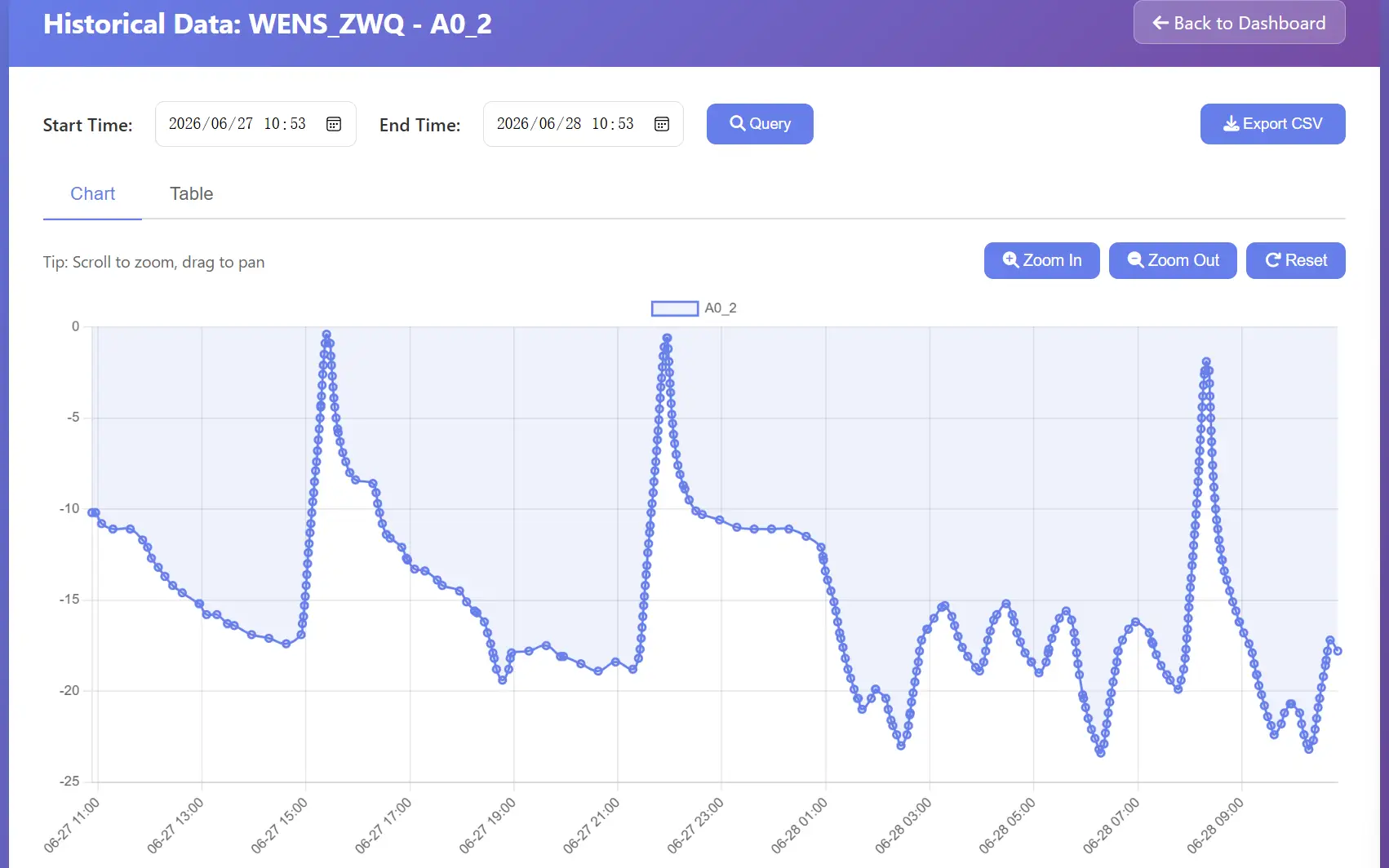
The cloud platform generates full-day temperature trend charts for intuitive visualization, clearly displaying the refrigerator's normal low-temperature baseline, sharp temperature spikes triggered by door openings, and all abnormal temperature fluctuations.
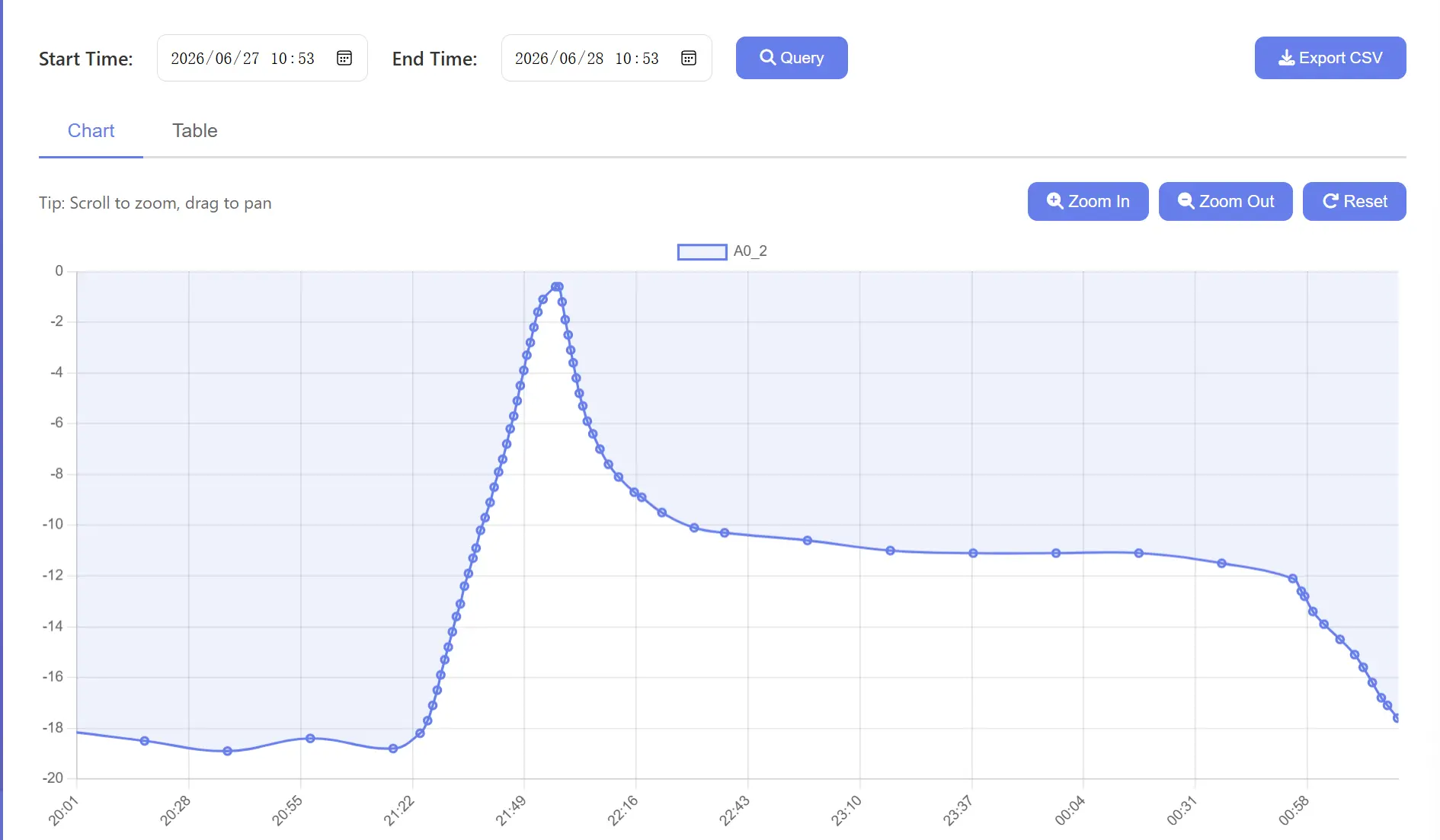
Zooming into time-series curves of specific time windows reveals every sampled data point transmitted to the cloud, which directly verifies stable and reliable data transmission performance.
Additionally, the device implements an adaptive reporting logic: it sends data at a high frequency when temperature fluctuates drastically, and reduces transmission frequency when readings remain stable. This mechanism effectively cuts down data transmission and cloud storage overhead.
Technical Specifications
| Measurement Range | Temperature: -40°C~85°C (-40°F~185°F) |
|---|---|
| Measurement Accuracy | Temperature: ±0.5°C(±0.9°F) |
| Number of measurement channels | Up to 2 channels supported |
| Connection method between probe and main body | Wired |
| Communication Protocol | Supports multiple TCP/IP application layer protocols: MQTT/MQTTS, ModbusTCP, SNMP, BACnet, REST API, email etc. |
| Connectivity | WiFi with native support for WPA-Enterprise and 802.1X authentication |
| Power Supply | USB Type-C 5V, DC 12V (range DC9~28V) terminal (inside the box) |
| Power Consumption | 0.5W |
| Operating Storage Temperature | -30~+85℃ (-22°F~185°F) |
| Product Dimensions | 86×86×48 mm |
Frequently Asked Questions
For questions about WiFi provisioning, fixed IP assignment, multiple device setup, and App usage, please refer to the MN-WTHM FAQ section.
Do I have to use the thin-wire probe for refrigerator/freezer monitoring?
This depends on your accuracy requirements and the installation environment. We tested both probe types at the same position inside the same refrigerator and found that the two probes agree well at room temperature. However, when measuring inside the refrigerator (where the internal temperature is approximately 25°C lower than room temperature), the thick-wire probe consistently reads 4–5°C higher than the thin-wire probe over extended periods.
This discrepancy is caused by heat conduction along the thicker cable and the probe's own thermal mass, which pulls heat from the warmer ambient air into the cold measurement environment. For applications requiring high measurement accuracy, the thin-wire probe is recommended.
Note that the thin-wire probe is physically more delicate than the thick-wire version, so adequate cable protection should be planned during routing and installation.
How does the stainless-steel probe housing affect measurements?
To withstand harsh environments, the sensing element is encapsulated inside a small stainless-steel cylinder for mechanical protection. This encapsulation, however, introduces a small measurement trade-off: it increases the probe's effective thermal mass, which slows the response to rapid temperature changes and acts as a natural smoothing filter.
During door-open/door-close testing on a refrigerator, we compared the encapsulated probe against a bare (unencapsulated) sensor. The bare sensor showed a peak temperature rise approximately 2°C higher than the encapsulated probe when the door was opened, confirming that the steel housing slightly dampens transient temperature spikes while still accurately tracking steady-state temperatures.
What is the maximum cable length for the probe? Can the probe wire be extended?
Although the MN-WENS uses a digital temperature probe, cable length should generally be kept within 5 meters to avoid electromagnetic interference that could corrupt readings.
If longer cable runs are required, two measures must be taken:
- Use shielded cable: Replace the standard cable with a shielded twisted-pair or shielded cable suitable for digital signals;
- Ground the shield properly: The cable shield must be terminated to a good earth ground at one end.
With proper shielding and grounding, cable lengths of over ten meters can be achieved while maintaining data integrity.