MN-NIO PoE Network IO Monitor | Industrial Multi-Protocol IoT Controller
Buy from Amazon


Origin: China | HS Code: 8517.62.3990
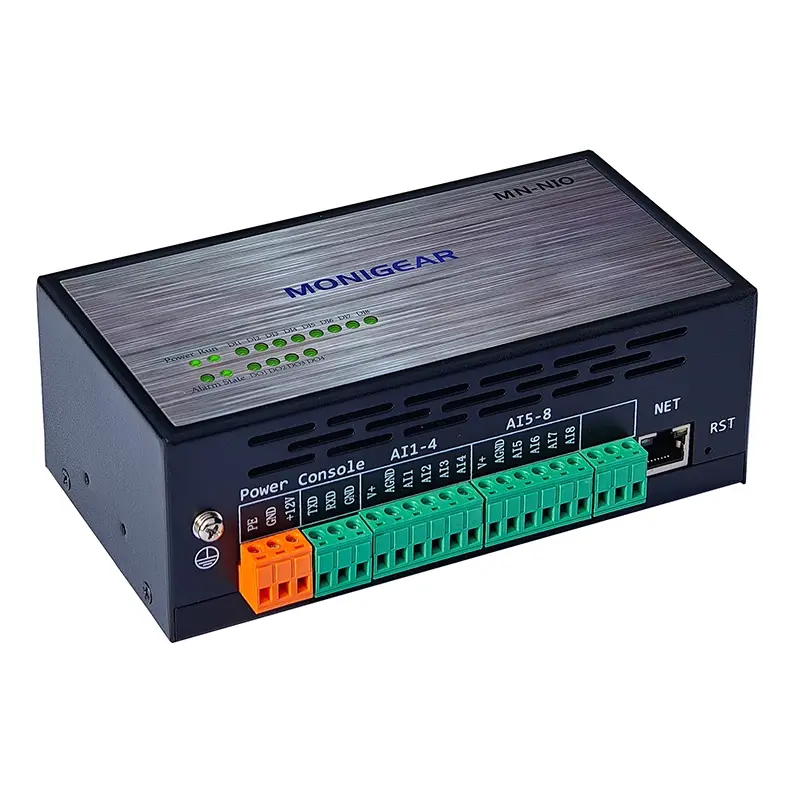
The MONIGEAR MN-NIO Network IO Monitor is a powerful, programmable industrial-grade IoT controller designed for SCADA systems, building automation, and remote monitoring applications. With 8 digital inputs, 4 digital outputs, 8 analog inputs (4-20mA), and advanced Lua scripting capabilities, this versatile device provides comprehensive monitoring, control, and intelligent automation.
Key Features
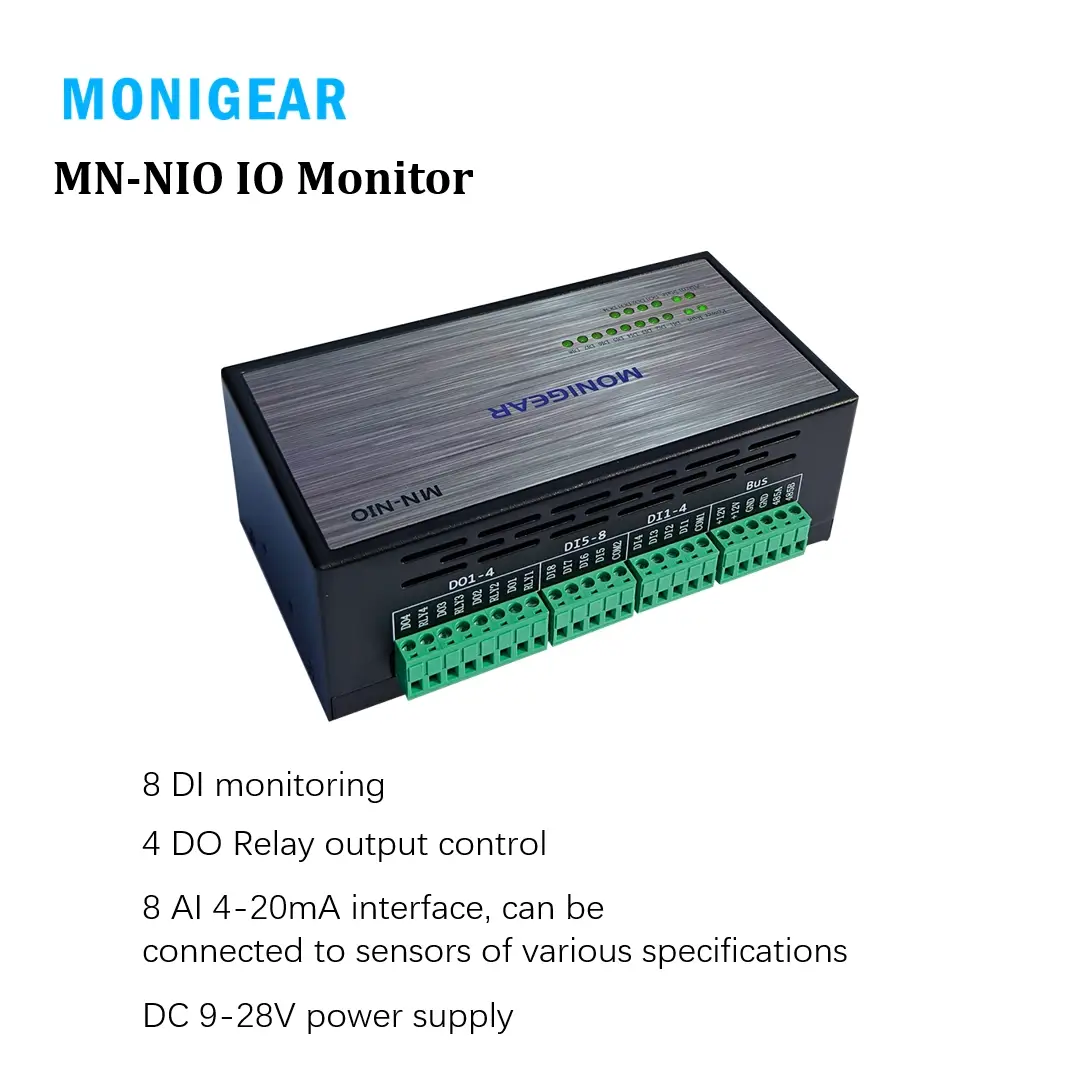
- 8 DI (Dry contact), 4 DO Relay output control, 8 AI 4-20mA interface can be connected to sensors of various specifications.
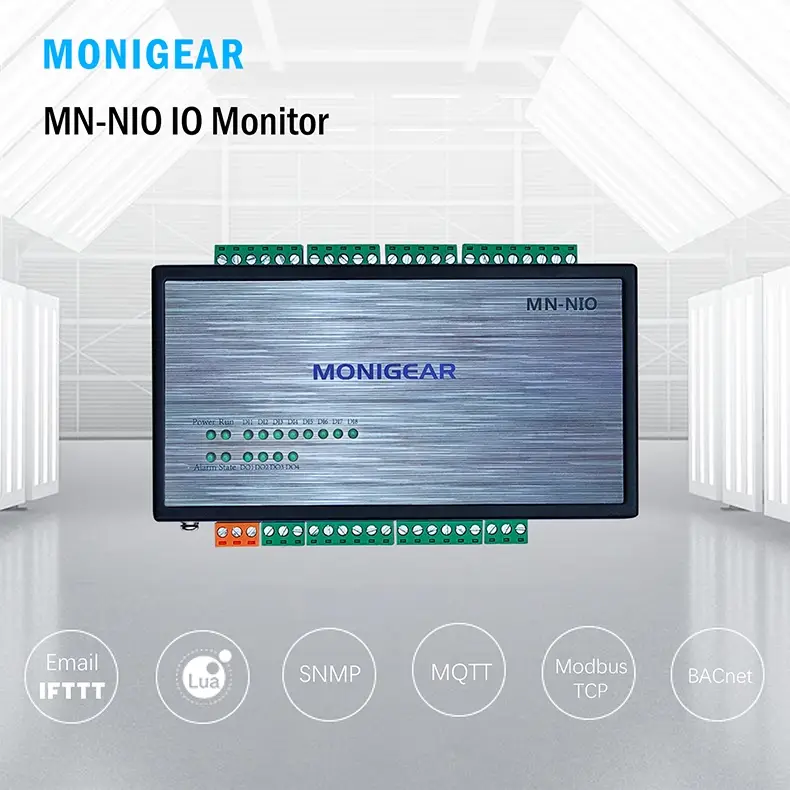
- Supports Multiple Industry-Standard Communication Protocols: Modbus TCP, SNMP, BACnet, and MQTT. Our system is compatible with all these protocols and can deliver data in multiple formats simultaneously. Comprehensive support for SNMP v1/v2/v3 and SNMP Trap v2c/v3. High security product: supports TLS encrypted communication, featuring both unidirectional and bidirectional certificate authentication capabilities.
- Advanced SNMP Support: Full compatibility with SNMP v1/v2/v3 and SNMP Trap v2c/v3, featuring enterprise-level security for critical infrastructure monitoring.
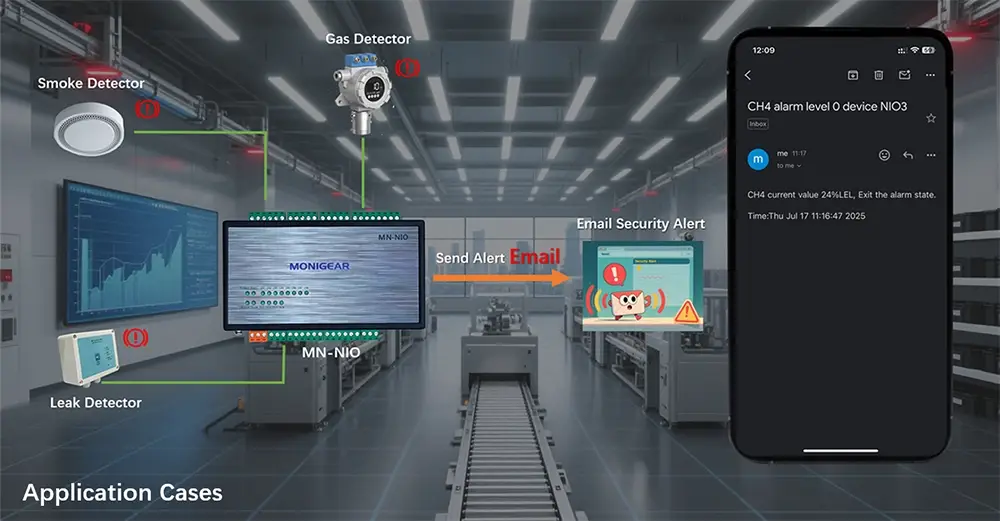
- Proactive Alerts - Instant email notifications when thresholds are exceeded (fully customizable triggers). IFTTT Automation - Trigger smart actions (e.g., activate HVAC, log to Google Sheets, or Telegram alerts) via Webhook integration.
- Using the standard MQTT protocol, a real IoT direct connected product, building a cost-effective application system for AWS/Azure/Tuya.
- Support Lua scripts for on-site logic programming, allows users to perform secondary development.
- Support IEEE 802.3af standard PoE power supply, and also support DC 12V auxiliary power supply.
- Easy to use: A graphical interface configuration tool supporting Windows, Linux, and macOS platforms with online remote upgrade capability for simplified product deployment and maintenance.
- Professional Certification: Certified through FCC/CE-EMC/ROHS, meeting the high standards and strict requirements of the market.
- Your Data, Your Control: MONIGEAR's sensor puts security first—whether cloud-connected or fully self-contained.
Typical Scenarios
For detailed information about the capabilities across all our Network Sensors, please visit our common features page.
Technical Specifications
| Digital Input | 8-channel DI digital input interface, Input signal type 1(IEC61131). DI1-DI4 are sink (IEC positive) type.DI5 and DI8 can be configured with the sink/source (IEC positive/negative)type. |
|---|---|
| Digital Output | 4-channel DO mechanical relay output interface.Switch capacity:5A, 240V AC/30V DC. |
| Analogue input | 8-channel Analogue 4-20mA current input interface.The input resistance is 100 ohms. |
| Network communication interface | 10/100M Base Tx Ethernet port (supports PoE power supply). |
| Communication Protocol | Support multiple TCP/IP based application layer protocols: MQTT/MQTTS,SNMP, Modbus TCP, BACNet. |
| Console interface | 1 RS232 configuration port, baud rate 115200bps, 8N1, no flow control. |
| Serial communication interface | 1 RS485 ports, maximum baud rate of 200Kbps, isolation voltage of3000VDC. |
| Power supply | You can choose between POE power supply or auxiliary power supply. POE power supply: Compatible with the IEEE 802.3at standard Auxiliary power supply: DC12V/DC24V. |
| Appearance size | Length*widget*hight(mm) = 166*88*61 |
| Weight | About 600g |
Frequently Asked Questions
What is the RS485 port used for?
Historically, the RS485 port was designed to allow SCADA monitoring software to read monitored data from the MN-NIO device using the Modbus RTU protocol. After Lua scripting support was added, however, this serial port gained much broader capabilities:
- It can still function as a serial port for upstream communication with host systems, though this role has largely been superseded by the MN-NIO's built-in Modbus TCP (Ethernet) capability;
- It can act as a master serial controller to interface with other RS485-enabled devices, enabling data acquisition and integration of third-party modules into the monitoring system.
For more information about Lua scripting capabilities and sample scripts, please contact our technical support team.
Do you offer OEM/ODM customization? Can the MN-NIO be powered by -48V DC?
Yes. Telecom operators commonly require -48V DC power, and we have the engineering expertise to deliver custom OEM/ODM products, including -48V-powered variants.
Additionally, the standard MN-NIO includes a comprehensive set of digital and analog I/O channels. For cost-sensitive applications, unused I/O channels can be removed (trimmed) to reduce unit cost.
As a reference, we previously partnered with a company in Eastern Europe to deliver a customized MN-NIO variant designed exclusively for telecom carrier use: a DI-only model with SNMP Inform functionality, deployed to monitor a large fleet of equipment rooms and distribution frames.
What can the programmable logic (Lua scripting) feature accomplish?
The MN-NIO supports Lua-script-based logic programming in two primary modes:
- Local I/O control: Based on the status of the MN-NIO's own DI/AI channels, scripts perform local logic evaluation to directly control DO output states, or send alarms and notifications over the network (e.g., via SNMP traps, email alerts, or MQTT messages).
- Serial expansion and multi-module integration: Through the RS485 port, scripts can communicate with external modules, combining data from multiple devices to perform cross-module logic judgments and control actions. This mode also enables virtual DI/DO/AI/AO data points to be derived and reported upstream to central monitoring software or cloud-based IoT platforms.
Lua scripting transforms the MN-NIO from a simple I/O gateway into a flexible edge controller capable of autonomous decision-making at the device level, reducing latency and reliance on central servers.