MN-NAM PoE Network Smart Device Monitor | Industrial Multi-Protocol IoT Controller
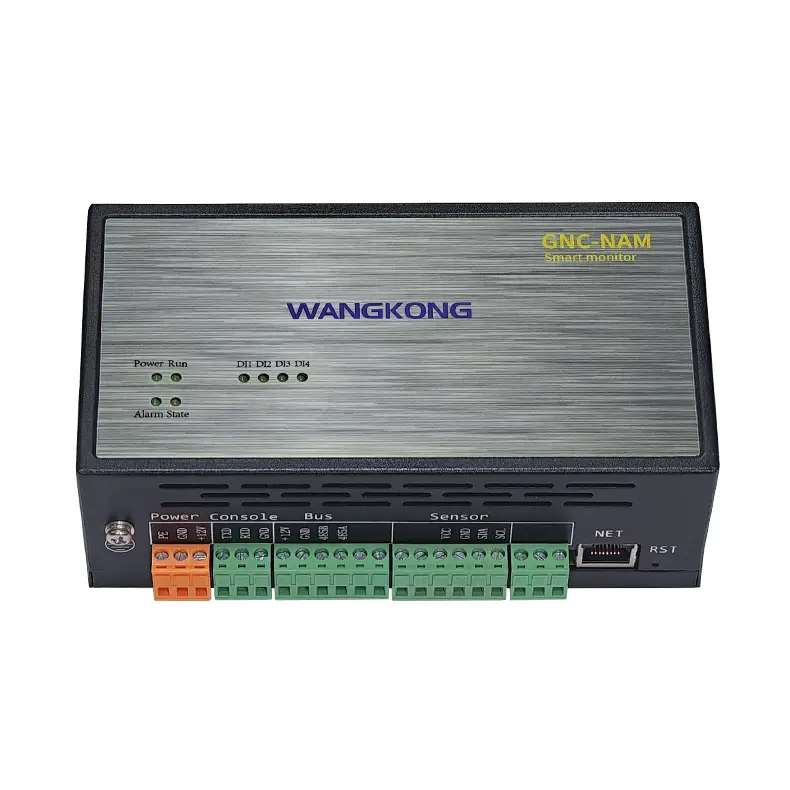
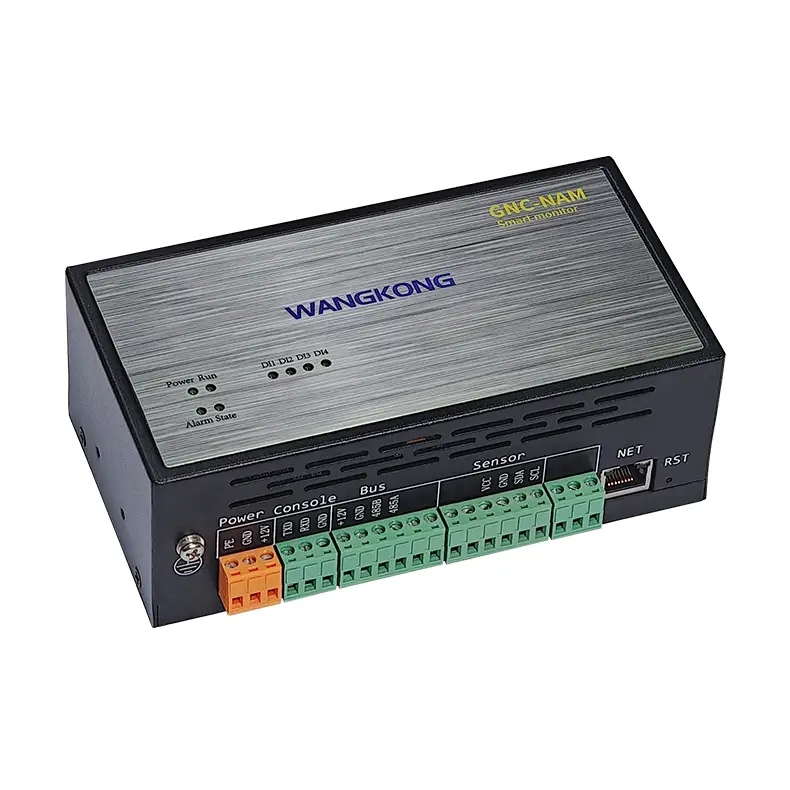
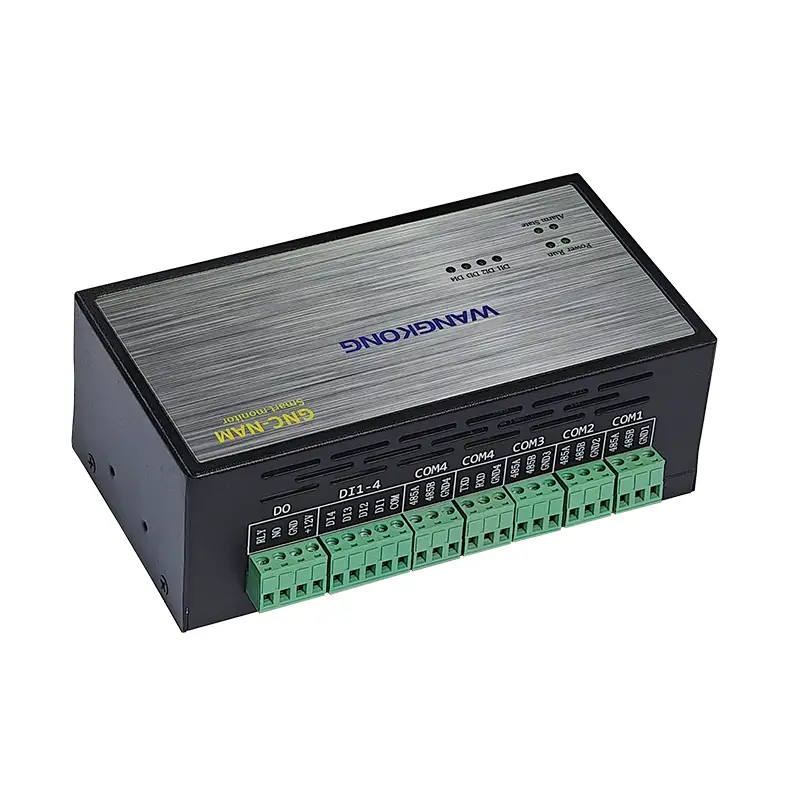
The MONIGEAR MN-NAM Smart Device Monitor supports multiple intelligent communication interface types such as RS232, RS485, and Ethernet, enabling real-time communication with front-end intelligent devices. By writing Lua scripts, it can parse the communication protocols of various intelligent devices and perform data preprocessing. As a standard IoT direct-connection device, NAM can be integrated into major IoT public cloud platforms, establishing a secure bidirectional connection between the device and the cloud, facilitating the rapid implementation of IoT projects.
Key Features
- High-performance industrial-grade 64-bit RISCV processor, embedded operating system.
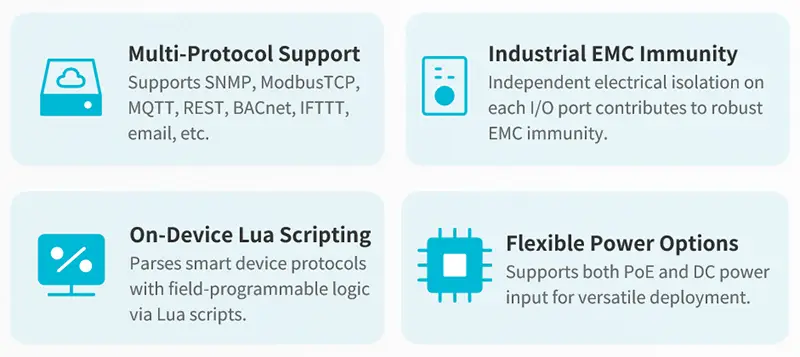
- Each intelligent communication port adopts an independent electrical isolation scheme, ensuring industrial-grade EMC immunity.
- The device side supports Lua script parsing of communication protocols for various smart devices and possesses on-site logic programmability. Based on predefined scenario rules and data analysis results, it can execute strategies locally or forward data to the cloud for processing, addressing issues such as real-time performance, reliability, and operational and maintenance economy of the application system.
- The communication protocol of smart devices is parsed and the monitoring data is preprocessed at the device end. The preprocessed data is then uploaded to the cloud. This hierarchical processing mechanism improves the real-time performance of some key services and effectively reduces the data communication volume between devices and the cloud, thereby significantly reducing the operation and maintenance costs of the system.
- It is convenient and easy to use, equipped with a companion device configuration tool, facilitating batch installation and quick configuration of products. It supports online remote upgrades for devices. It is convenient for product deployment and maintenance, effectively reducing labor costs.
- POE power supply: compliant with IEEE 802.3at standard, POE powered device (PD device), Type 1 device, supporting both Mid-Span and End-Span power supply modes. Simplified installation, facilitating the deployment of centralized UPS power supply for protection.
- The device supports the standard MQTT IoT communication protocol, boasting secure, stable, and efficient IoT communication connectivity, facilitating rapid data communication between devices, applications, and cloud services.
- It supports simultaneous access to two cloud platforms and can send data to two centers simultaneously, achieving a redundant backup system.
Typical Scenarios
For detailed information about the capabilities across all our Network Sensors, please visit our common features page.
Technical Specifications
| Serial communication interface | 4 x RS485 ports: up to 200 Kbps, 3000 VDC isolation. 1 x RS232 port (multiplexed with RS485 Port 4): up to 115.2 Kbps, 2500 VDC isolation. |
|---|---|
| DI interface | 4-channel DI digital input interface. |
| DO interface | 1-channel DO mechanical relay output interface. Switch capacity: 0.5 A @125 VAC; 2 A @30 VDC. |
| Network communication interface | 10/100M Base-Tx Ethernet port (supporting POE power supply). |
| Communication protocol | Supports multiple TCP/IP application layer protocols: MQTT/MQTTS, ModbusTCP, SNMP etc |
| Console interface | One RS232 configuration port, baud rate 115200bps, 8N1, no flow control. |
| Power supply | You can choose between POE power supply or auxiliary power supply. POE power supply: Compatible with the IEEE 802.3at standard Auxiliary power supply: DC12V. |
| Appearance size | Length*widget*hight(mm) = 166*88*61 |
| Weight | About 600g |
Frequently Asked Questions
Unlike Monigear's other standalone sensors and data acquisition devices that are sold as individual hardware units, the MN-NAM is not positioned as a standalone hardware product. It is deeply integrated with our proprietary monitoring software and cloud services. Only when deployed as a complete hardware + software + cloud solution can the MN-NAM fully deliver its core advantages — edge computing, protocol parsing, dual-cloud redundant backup, and remote O&M — providing a closed-loop monitoring solution for your projects.
1) What smart devices can the MN-NAM gateway connect to, and what scenarios is it primarily used for?
The MN-NAM is an industrial-grade multi-protocol PoE acquisition gateway designed specifically to interface with non-managed, non-standard smart devices equipped with RS232/RS485 serial ports. It is primarily deployed in data center and equipment room environment and infrastructure monitoring, and is equally applicable to laboratories, pharmaceutical workshops, museums, warehousing and logistics, smart manufacturing, and other environmental monitoring scenarios.
Common equipment types connected in data center projects include: precision air conditioners, UPS systems, telecom power supplies and power distribution cabinets, multi-function digital power meters, and battery monitoring instruments. In industrial scenarios, it can connect to PLCs, variable frequency drives (VFDs), various industrial instruments, and laboratory precision equipment.
Most of the above devices output only serial-port proprietary protocols and lack network management capability, making them impossible to connect directly to a monitoring platform. The MN-NAM performs on-site data acquisition, protocol parsing, and edge data preprocessing, establishing the data pipeline between field terminal devices and local O&M platforms or cloud monitoring systems, enabling unified access and monitoring of device data.
2) As an acquisition gateway, what are the core capabilities and advantages of the MN-NAM in data conversion and platform integration?
Powered by a 64-bit RISC-V industrial processor and isolated serial port hardware, the MN-NAM far exceeds ordinary serial device servers in hardware stability and functionality. Its core advantages include:
- Standardizing non-standard data for compatibility with traditional monitoring systems: The MN-NAM converts proprietary protocol data from various non-managed serial devices into standard SNMP monitoring data, enabling direct integration with NMS platforms and traditional data center infrastructure monitoring systems — no need to replace your existing monitoring software, maximizing the return on your current system investment.
- Encrypted cloud connectivity with major public cloud platforms: Built-in secure MQTT/MQTTS IoT encrypted protocol ensures stable and secure data transmission. Natively supports AWS IoT, Azure IoT, and other leading public cloud platforms, meeting the remote cloud monitoring deployment needs of overseas data centers and multinational projects.
- Dual-platform concurrent upload for redundancy and reliability: Supports simultaneous data push to two local monitoring systems or two cloud platforms, enabling a hot-standby architecture. This effectively prevents data loss caused by single-point network failures — ideal for data centers, financial institutions, and other scenarios with extremely high O&M reliability requirements.
- Integration with our proprietary AWS-based cloud monitoring system: We are launching our own IoT cloud monitoring system built on AWS infrastructure. Paired with the MN-NAM gateway, it enables a full closed-loop workflow covering unified device management, remote configuration, alarm push notification, and historical data storage — without requiring customers to purchase third-party cloud services.
3) How does the MN-NAM handle protocol parsing and data processing? What are the characteristics of the Lua scripting solution? How do you address the development learning curve?
Device protocol parsing, data cleaning, threshold evaluation, and local interlock control on the MN-NAM all run locally on the gateway via embedded Lua scripts. Leveraging edge computing, the MN-NAM breaks through the limitation of ordinary serial servers that only support raw data passthrough — this is a core product differentiator.
Key advantages of the Lua scripting approach:
- Adapts to diverse complex proprietary protocols: Supports parsing of brand-specific serial protocols and Modbus RTU/TCP, with full control over packet parsing, data scaling/conversion, and abnormal data filtering for fine-grained data processing.
- Edge preprocessing reduces costs and improves response: Raw device data is cleaned, compressed, and statistically processed locally at the gateway before being uploaded to the cloud, significantly reducing cloud bandwidth and storage costs. The gateway also supports local alarm generation and relay DO interlock output — responding to device faults instantly even during network outages, with no cloud transmission delay.
- Field-programmable with strong adaptability: No firmware modifications or factory returns are required. Lua scripts can be updated remotely to support entirely new device models, perfectly accommodating multi-brand, multi-type mixed-deployment project environments.
Lua is a lightweight embedded scripting language that is considerably easier to learn than traditional C/C++ development, though it does still require a basic programming foundation. We provide comprehensive support to reduce customer adoption costs:
- Mature script resource library: Equipped with complete technical documentation and backed by hundreds of domestic device integration projects, we maintain an extensive library of proven sample scripts covering UPS systems, precision air conditioners, digital power meters, and other mainstream equipment — ready for customers to modify and reuse directly.
- AI-assisted development and debugging: Customers can leverage AI tools to rapidly generate and debug protocol parsing scripts, significantly shortening project development and deployment cycles.
- Low-cost custom development service: For customers without a dedicated development team or with tight project timelines, we offer custom script development services delivered by our engineers — handling protocol adaptation and script development for a worry-free, efficient deployment.